
Showing posts sorted by relevance for query scorpionfish. Sort by date Show all posts
Showing posts sorted by relevance for query scorpionfish. Sort by date Show all posts
Monday, March 19, 2007
Not just 2, but 3
Diane and I found yet another Weedy/Lacy Scorpionfish at Tasi Tolu on Sunday. The two new additions lead us to believe that our first resident was actually a Lacy Scorpionfish, not a Weedy Scorpionfish. I realize this may result in a difficult night's sleep for many UWET readers, and I offer my deepest (about 20 meters) apologies.


Saturday, January 02, 2010
Pregnant Lacy Scorpionfish
Rhinopias aphanes
I was exploring the edge of the top shelf of Tasi Tolu yesterday, just before the slope at about 8 meters. I was thinking about the various sponges, algae, and corals that form habitats for all the great creatures we find at TT. To my delight, I found a pregnant Lacy Scorpionfish! This indivudual is usually much deeper, at 17 meters in the weedy patch. After a bit of research, I learned that scorpionfishes lay an eggsack on the surface. And my guess is that this guy was making his way to the surface to deposit his brood. And yes, it's male: Adult males are smaller than females and according to the research, they carry the eggs.
I realize it's difficult to see, but the Lacy Scorpionfish is on the bottom left of the coral in the first photo. You can click on the photo to enlarge it a bit.


I was exploring the edge of the top shelf of Tasi Tolu yesterday, just before the slope at about 8 meters. I was thinking about the various sponges, algae, and corals that form habitats for all the great creatures we find at TT. To my delight, I found a pregnant Lacy Scorpionfish! This indivudual is usually much deeper, at 17 meters in the weedy patch. After a bit of research, I learned that scorpionfishes lay an eggsack on the surface. And my guess is that this guy was making his way to the surface to deposit his brood. And yes, it's male: Adult males are smaller than females and according to the research, they carry the eggs.
I realize it's difficult to see, but the Lacy Scorpionfish is on the bottom left of the coral in the first photo. You can click on the photo to enlarge it a bit.


Saturday, November 01, 2008
Lacy Scorpionfish
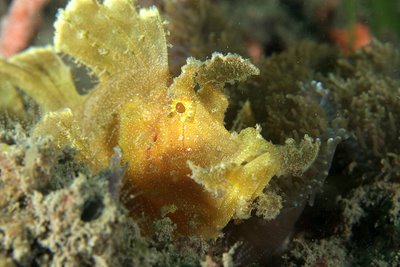
Diane and I spotted this lacy scorpionfish on Thursday night, but due to technical difficulties couldn't take a photograph. We went back to Tasi Tolu this morning and found it sitting near the fallen sponge coral. Under our flashlights and strobes, this individual appears to have a lavender tint, but underwater looks exactly like the green algae that makes Tasi Tolu such a great hiding place.
I did a quick search of UWET for other scorpionfish and was surprised to find that it's been over a year since our last spotting of a lacy.


I did a quick search of UWET for other scorpionfish and was surprised to find that it's been over a year since our last spotting of a lacy.


Tuesday, July 25, 2006
Juvenile Scorpionfish
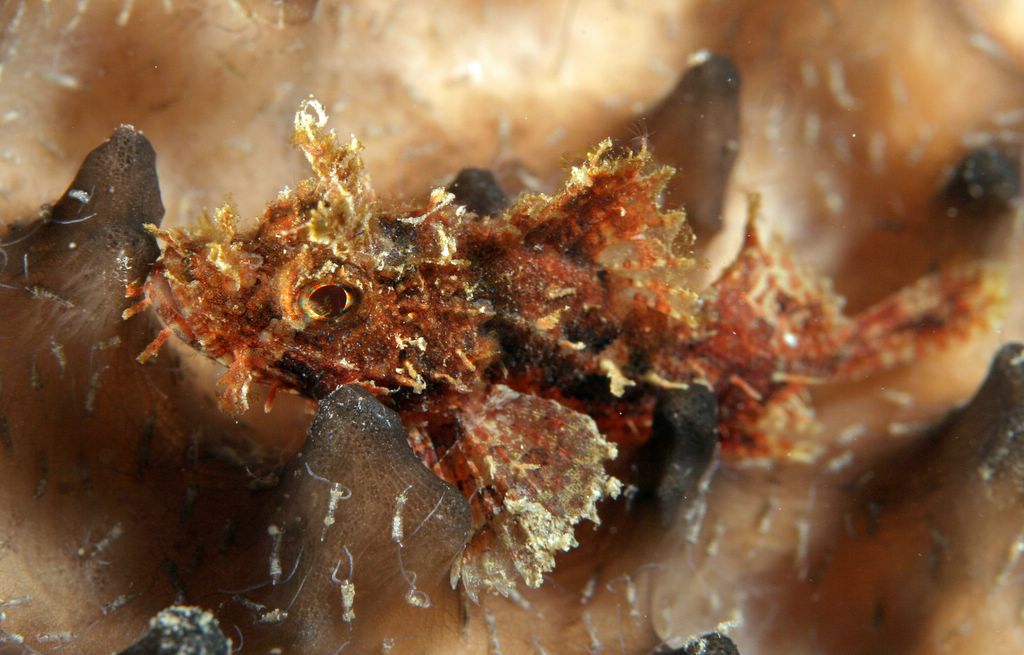
Juvenile Scorpionfish (35mm). The scorpionfish was on a barrel sponge covered with thousands of evenly spaced shrimps which must have been no more that 1mm in length.
Sunday, March 18, 2007
Weedy Scorpionfish X 2
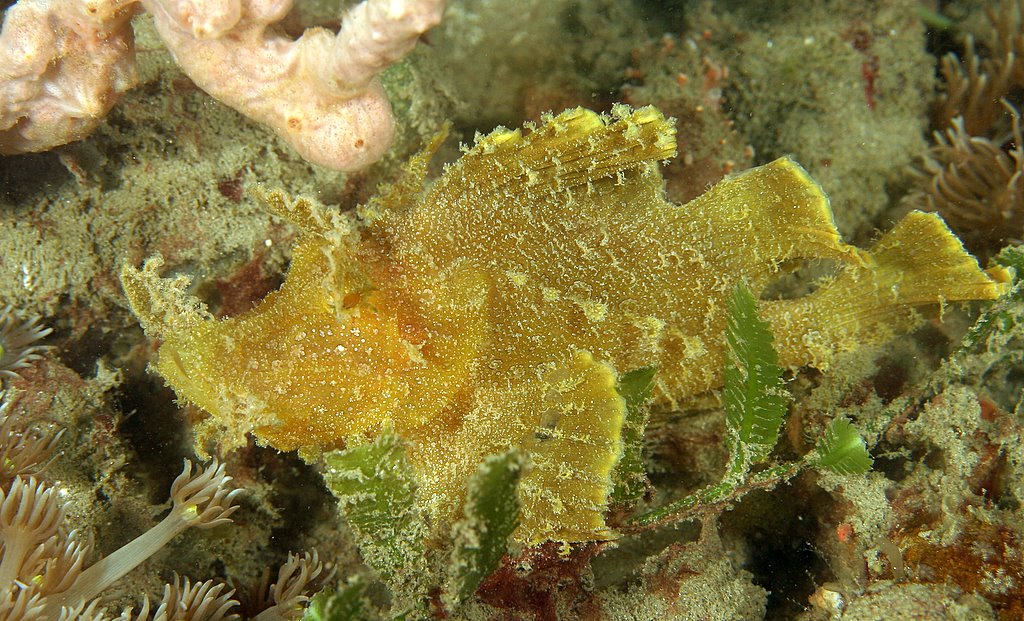
Our resident Weedy Scorpionfish now has a mate! The larger of the two (rear of first photo) has been hanging out at Tasi Tolu for many months now. Diane and I went for a visit yesterday and discovered she (?) has a new beau, and he's really cool.


Thursday, November 18, 2010
Tasi Tolu Night Dive
Thanks to Marcella, Jenny, and Sarah for a wonderful night dive at Tasi Tolu.
This first shot is of two Demon Stingers or Devil Scorpionfish (Inimicus didactylus).

Our friendly Lacy Scorpionfish.

This Orangutan Crab (Achaeus japonicus) is a founding member of the hair club for crabs. As the name suggests, usually these crabs are completely covered with orange-red hairs.

Bobtail Squid


This first shot is of two Demon Stingers or Devil Scorpionfish (Inimicus didactylus).

Our friendly Lacy Scorpionfish.

This Orangutan Crab (Achaeus japonicus) is a founding member of the hair club for crabs. As the name suggests, usually these crabs are completely covered with orange-red hairs.

Bobtail Squid


Sunday, January 10, 2010
Weedy Scorpionfish
Thanks to Joel Gaunt for joining me this afternoon for a rough but rewarding dive at Tasi Tolu. This was Joel's first dive in Timor...and I dare say it's going to be tough to beat! Conditions were terrible, but it was creature feature, including the new discovery of this weedy scorpionfish hanging out about 30 meters west of the patch.


Saturday, August 25, 2007
Lacy Scorpionfish
We've suspected for some time that these two lacy/weedy scorpionfish were "having a relationship" and now it is apparent the female is, in fact, pregnant. The photos are of the smaller male; he's more decorative and "lacy"


Sunday, February 18, 2007


Sunday, November 02, 2008
Lacy Scorpionfish in full color
The lacy scorpionfish was a bit cleaner today, revealing the full color of its body. I must have kept my focus on it for 10 minutes today, waiting for a good yawn. No luck.


Monday, August 20, 2007
Juvenile Scorpionfish
Emre and I had a nice evening dive at Dili Rock, but Timor divers should be prepared to see the devastating effects of last week's storm. Most of the coral along the ridge above 14 meters has been crushed to rubble. This has happened before though and we are always amazed at how quickly habitats are restored and life returns.
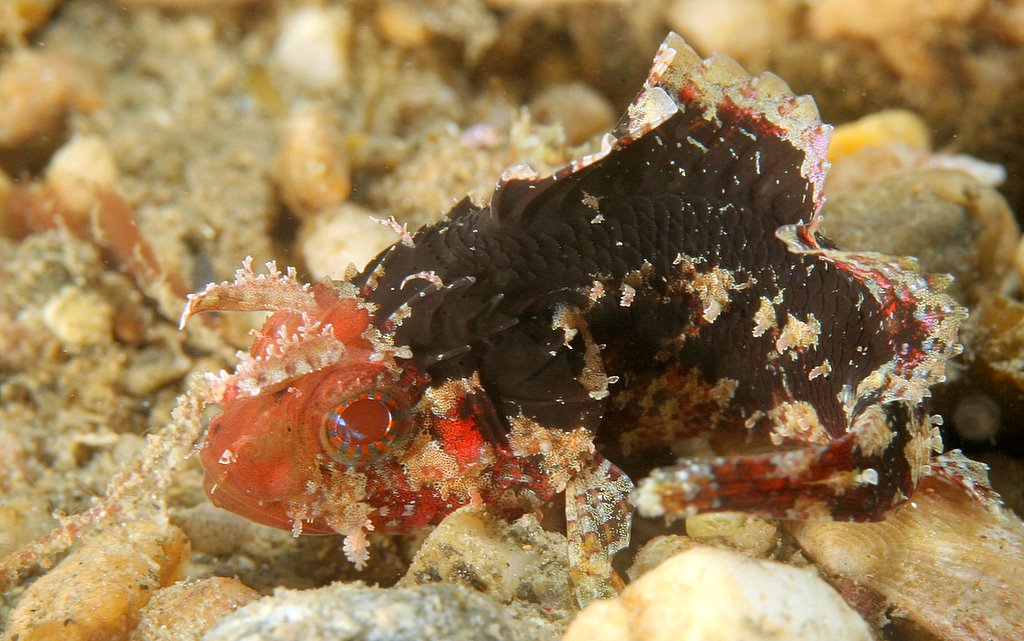
We found this juvenile scorpionfish watching the nightfall on a red fan coral.


We found this juvenile scorpionfish watching the nightfall on a red fan coral.


Thursday, October 26, 2006
Tuesday, November 13, 2007


Saturday, August 25, 2007
Demon Stinger
We found this Demon Stinger at Tasi Tolu on Tuesday night. This is very good reason to stay off the bottom at TT. There are lots of unknown creatures hidden in the weedy patch. We also spotted two sets of scorpionfish on the dive.


Wednesday, May 19, 2010

Tuesday, December 30, 2008
Stonefish Poisoning
A few days ago I was lying on the sand at Tasi Tolu, mesmerized while photographing a lacy scorpionfish. I generally anchor myself in the sand with a steel pointer and stay a few inches off the bottom. And it's a good thing. I felt something moving under me and raised off the bottom to discover a small stonefish (about 20cm). This brush with danger made me consider what I would have done had I been 'stung' by the dorsal spines of the stonefish...especially given the lack of medical services here in Timor.

So here's a bit of advice from the Wildness Medical Society in Australia.
Proper management of stonefish poisoning involves immediate evaluation and stabilization of the patient. The wounds should be explored and copiously irrigated using sterile techniques. This cleanses the wound area and may remove venom as well as components of the spine, slime, and sand. Any foreign material left in the wound is likely to delay or arrest the healing process. Stonefish venom is heat labile; therefore, hot soaks (115°F/45°C) should be performed for 30 to 90 minutes or until the pain is relieved and does not recur. The wound may be infiltrated with local anesthetic without epinephrine if pain relief is required. Systemic analgesics or narcotics are rarely needed. General wound care should be administered, including antibiotics if indicated. The affected area should be elevated. Antivenom administration should be considered in cases of severe stonefish poisoning. This should be given as soon as possible after the initial sting, preferably within 48 hours.
Let's hope we never have to apply this knowledge, but there's more info if you follow the link to WMS.
Note: Lidocaine, xylocaine, prilocaine and mepivicaine (Isocaine) are common local anesthetics that are available without epinephrine.

So here's a bit of advice from the Wildness Medical Society in Australia.
Proper management of stonefish poisoning involves immediate evaluation and stabilization of the patient. The wounds should be explored and copiously irrigated using sterile techniques. This cleanses the wound area and may remove venom as well as components of the spine, slime, and sand. Any foreign material left in the wound is likely to delay or arrest the healing process. Stonefish venom is heat labile; therefore, hot soaks (115°F/45°C) should be performed for 30 to 90 minutes or until the pain is relieved and does not recur. The wound may be infiltrated with local anesthetic without epinephrine if pain relief is required. Systemic analgesics or narcotics are rarely needed. General wound care should be administered, including antibiotics if indicated. The affected area should be elevated. Antivenom administration should be considered in cases of severe stonefish poisoning. This should be given as soon as possible after the initial sting, preferably within 48 hours.
Let's hope we never have to apply this knowledge, but there's more info if you follow the link to WMS.
Note: Lidocaine, xylocaine, prilocaine and mepivicaine (Isocaine) are common local anesthetics that are available without epinephrine.
Saturday, January 02, 2010

Thursday, April 23, 2009


Monday, August 13, 2007
Sunday at Dili Rock West
We had our first crystal clear dive in recent memory at Dili Rock West on Sunday. Found this scorpionfish trying to hide in a bunch of soft corals.


Sunday, January 14, 2007
Tasi Tolu Sunday
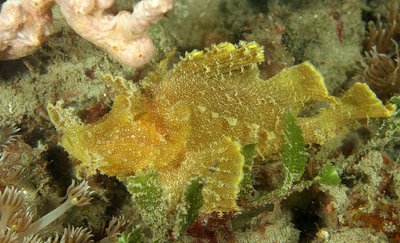
We found a rare and amazing "Weedy Scorpionfish" this morning at Tasi Tolu, 18 meters. It may be Rhinopias frondosa, but I'm not quite sure of the species name.



Subscribe to:
Posts (Atom)